
What Do You Actually Value?
A practical guide to values, character strengths and living more authentically.
Values can sound abstract until life asks us to choose between two things that matter. That is often where we discover what we truly stand for.
Most of us could produce a respectable list of values if asked: family, freedom, integrity, kindness, growth, health, security, creativity, connection and the list goes on. But knowing the words is not necessarily the same as knowing our values. Because values become interesting when they meet real life: when freedom conflicts with security, when honesty risks belonging, when family competes with work, when ambition costs wellbeing, when kindness requires a boundary, when the life we have built reflects values we once held, but perhaps no longer do. That is where values stop being attractive nouns and begin becoming a way of orientating ourselves. The question is not simply: what values do I admire? It is: what do I want my life and my choices to stand for? And perhaps even more importantly: can I see those values in the way I am actually living?
WHAT ARE VALUES?
Values are the qualities, principles and directions that matter to us. They are not rules, they are not achievements and they are not necessarily fixed for life. A value might be freedom, contribution, honesty, family, beauty, learning, courage, stability, compassion or independence but the word alone tells us surprisingly little. Two people can both value freedom and mean completely different things. For one person, freedom may mean financial independence, for another, having control over their time, for another, being able to speak honestly, for someone else, freedom may mean refusing to build a life around other people's expectations. So identifying the word is only the beginning. The deeper work is asking: what does this value mean to me?
Here are a set of the most common values.
| Abundance | Calmness | Credibility | Family | Independence | Mindfulness | Service | Resourcefulness | Uniqueness |
|---|---|---|---|---|---|---|---|---|
| Acceptance | Caring | Curiosity | Friendships | Individuality | Motivation | Spirituality | Responsibility | Usefulness |
| Accountability | Challenge | Daring | Flexibility | Innovation | Optimism | Stability | Responsiveness | Versatility |
| Achievement | Charity | Decisiveness | Freedom | Inspiration | Open-mindedness | Peace | Security | Vision |
| Adventure | Cheerfulness | Dedication | Fun | Intelligence | Originality | Perfection | Self-control | Warmth |
| Advocacy | Cleverness | Dependability | Generosity | Intuition | Passion | Playfulness | Selflessness | Wealth |
| Ambition | Community | Diversity | Grace | Joy | Performance | Popularity | Simplicity | Wellbeing |
| Appreciation | Communication | Empathy | Growth | Kindness | Personal development | Power | Stability | Wisdom |
| Attractiveness | Commitment | Encouragement | Flexibility | Knowledge | Proactive | Preparedness | Success | Zeal |
| Autonomy | Compassion | Engagement | Happiness | Leadership | Professionalism | Proactivity | Teamwork | |
| Balance | Cooperation | Enthusiasm | Health | Learning | Quality | Professionalism | Thankfulness | |
| Being the best | Collaboration | Ethics | Honesty | Life-long learning | Recognition | Punctuality | Thoughtfulness | |
| Benevolence | Consistency | Excellence | Humility | Love | Risk taking | Relationships | Traditionalism | |
| Boldness | Contribution | Expressiveness | Humour | Loyalty | Safety | Reliability | Trustworthiness | |
| Brilliance | Creativity | Fairness | Inclusiveness | Making a difference | Security | Resilience | Understanding |
Values are different from goals and this distinction matters. A goal can be completed, a value cannot. You can achieve the goal of changing careers, but you cannot finish freedom. You can complete a degree, but you cannot complete learning. You can get married, but you cannot tick love off a list. Values are closer to directions than destinations. Imagine travelling west. You can arrive at many places while travelling west, but there is no final point at which you have completed “west”.
Goals work in a similar way, they give values form. If creativity matters to you, finishing a book might be a goal. If connection matters, having dinner with a friend each week might be a goal. If health matters, protecting three evenings for rest or movement might be a goal. The goal is the action or outcome, the value tells you why it matters.
Values are also different from character strengths This is where another useful psychological framework comes in. The VIA Character Strengths framework identifies 24 character strengths organised across broader virtue categories such as wisdom, courage, humanity, justice, temperance and transcendence. These include strengths such as: creativity, curiosity, judgment, love of learning, perspective, bravery, perseverance, honesty, zest, love, kindness, social intelligence, teamwork, fairness, leadership, forgiveness, humility, prudence, self-regulation, appreciation of beauty, gratitude, hope, humour and spirituality.
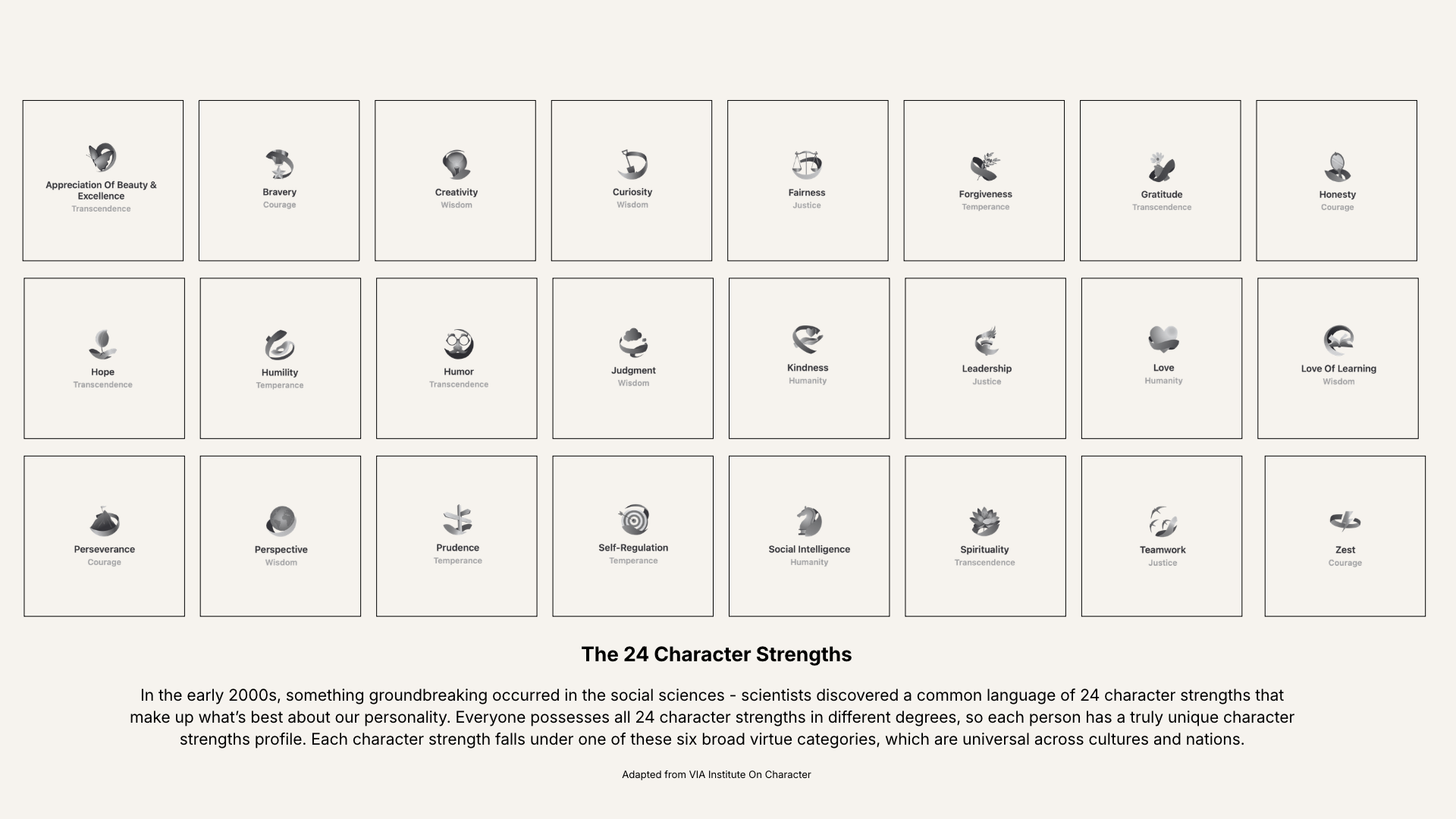
We all have access to these strengths in different degrees. Your values and your character strengths may overlap, but they are not the same thing. A useful distinction is:
Your values help answer: What matters?
Your strengths help answer: What capacities can I draw upon to live it?
If you value truth, honesty may help you enact it. If you value growth, curiosity and love of learning may support it. If you value connection, kindness, love or social intelligence may help you express it. If you value independence, bravery and perseverance may be especially useful when acting on it requires you to disappoint someone. Your strengths can become the bridge between what you say matters and what you actually do.
THE VALUES WE INHERIT
One reason values work can become uncomfortable is that not every value we carry was consciously chosen. Families have values, cultures have values, schools have values, workplaces have values, religious and social systems have values, friendship groups have values and we absorb many of these long before we are capable of examining them.
Achievement may have brought approval. Being agreeable may have preserved harmony. Success may have meant security. Caring for everybody else may have been treated as goodness. Independence may have been praised, or discouraged. None of this automatically makes an inherited value wrong. The question is whether it still belongs to us. A value can originate outside us and still become genuinely ours. Authenticity does not require rejecting everything we have inherited, it requires discernment: do I still choose this? That is a very different question from: was I taught this?
Sometimes our lives reveal our values before our words do. If you want to understand what currently governs your life, look at what repeatedly receives your: time, attention, money, energy, sacrifice and emotional investment. This can be uncomfortable. You may say that health matters, while repeatedly placing it beneath work. You may say that family is central, while giving them whatever energy remains. You may value creativity but have designed a life with no space for it. You may say you value freedom while consistently choosing certainty. This does not necessarily mean you are hypocritical. Life contains constraints, people have responsibilities and some periods require one value to take precedence over another. But the gap between stated values and lived values is worth examining. Not to judge yourself but to become more conscious.
A PRACTICAL WAY TO IDENTIFY YOUR VALUES
You do not need to find the perfect five words immediately. Start with evidence from your life.
1. Look for moments that felt deeply right
Think of three moments when you felt: proud, alive, fulfilled, at peace, or deeply yourself.
What was happening?
What mattered about the experience?
What value might have been present?
Perhaps you felt alive while travelling alone so the obvious value might appear to be travel. But underneath it might be freedom, exploration, beauty or independence. Go beneath the activity.
2. Look at what makes you angry
Anger can sometimes reveal a violated value. If dishonesty affects you strongly, perhaps truth or integrity matters deeply. If exclusion bothers you, perhaps fairness or belonging is important. If somebody controlling your time produces a strong reaction, autonomy may matter. The emotion is not itself the value, but it can point towards one. Ask yourself: what principle feels as though it has been violated here?
3. Look at envy differently
Envy is not always something to suppress, sometimes it contains information.sIf somebody else's life creates a strong reaction in you, ask what you are actually responding to. Their money orr the freedom you imagine their money provides? Their career or their creative expression? Their relationship or the sense of companionship? Their confidence or their willingness to take up space? You may not want their life, you may simply be recognising something missing from yours.
4. Notice your recurring longings
What do you keep saying you want more of: space, adventure, meaning, stability, community, beauty, learning, peace, recognition, creativity, rest. These repeated desires are worth paying attention to.
KNOWING YOUR VALUES IS ONE THING. LIVING THEM IS ANOTHER.
The Authenticity Activation helps you explore the expectations, values and choices shaping your life — and identify what genuinely belongs to you.
HOW TO LIVE YOUR VALUES
1. Narrow the list
Once you have a larger set of possible values, reduce it, five is usually enough to work with meaningfully. If you choose fifteen, everything remains important and therefore very little becomes prioritised. Try comparing them two at a time. If you could protect only one of these in a difficult decision, which would matter more: freedom or security? growth or stability? achievement or wellbeing? harmony or honesty?
There is no universally correct hierarchy and your answer may change depending on the context. The purpose is not to create a rigid ranking, it is to understand where tensions exist.
2. Define your values in your own language
Do not stop at the label. For each core value, finish this sentence:
For me, ___________[VALUE]___________ means _____________________
For example:
Freedom means having enough autonomy to make meaningful choices about my time and direction.
Integrity means being willing to act consistently with what I believe, even when that is inconvenient.
Family means being emotionally present, not simply fulfilling responsibilities.
Growth means remaining curious and willing to revise what I think I know.
Now the value begins to become usable.
3. Turn a value into behaviour
This is where values work becomes practical. Choose one value and ask: if someone watched my life for the next seven days, what would they see if I were living this value?If your value is connection, perhaps they would see you put your phone away during dinner. If it is creativity, they might see you protect an hour for writing. If it is health, perhaps they would see you go to bed rather than complete another unnecessary task. If it is courage, they might see you have the conversation you have been avoiding. If it is freedom, perhaps they would see you say no to an obligation that no longer makes sense. This is where a value becomes embodied.
4. The Values Alignment Audit
Take your five core values. For each one, give yourself two scores from 0 – 10.
Importance - how important is this value to me now?
Alignment - how much does my current life reflect it?
You might discover:
| Value | Importance | Current alignment |
|---|---|---|
| Family | 10 | 8 |
| Freedom | 9 | 4 |
| Creativity | 8 | 2 |
| Health | 9 | 5 |
| Learning | 7 | 8 |
The most useful number will be the gap. A large gap does not mean you have failed, it simply points towards something worth exploring. Ask yourself: what is creating this gap? Is it circumstance, fear, habit, lack of resources, another competing value, an expectation you have never questioned or simply a season of life in which something else has legitimately needed more attention? The answer creates self-awareness.
5. Use character strengths to close the gap
Now bring your strengths into the exercise. If you have completed the VIA Character Strengths assessment, look at your highest or most natural strengths. Then ask yourself: which strength could help me live this value more fully? Suppose your value is authenticity, but you are finding it difficult to speak honestly in a relationship. You might draw on:
bravery — to tolerate the discomfort of speaking;
honesty — to communicate accurately;
social intelligence — to understand how and when to have the conversation;
kindness — to speak truth without unnecessary cruelty;
perspective — to hold the wider picture.
This matters because values work can otherwise become another exercise in identifying what is wrong. Strengths shift the question from: why am I not doing this? to: what do I already possess that could help me?
6. Try the Values – Strengths Matrix
Take one core value and one character strength, then complete:
I value…
I can use my strength of…
This week that might look like…
For example:
I value: freedom
Strength: bravery
Action: declining one commitment I no longer genuinely want to carry.
Or:
I value: connection
Strength: social intelligence
Action: asking somebody how they really are and staying present long enough to hear the answer.
Or:
I value: learning
Strength: curiosity
Action: spending thirty minutes exploring a question rather than scrolling.
The point is not to create another self-improvement regime, it is to translate something abstract into lived behaviour.
7. When two values conflict
One of the most useful things values work can do is help us understand why certain decisions feel difficult. Often the problem is not that we do not know what matters, it is that two things matter at once: freedom and security, family and ambition, honesty and belonging, compassion and self-respect, adventure and stability. There may be no decision that satisfies both perfectly, so instead of asking: which option is right, try asking:
Which value does each option protect?
Which value would I be asking myself to compromise?
Is that compromise temporary or chronic?
Which choice would I find easier to respect myself for later?
Values do not eliminate complexity. They help us see what the complexity is actually made of.
8. Values are allowed to change
A life chosen according to your values ten years ago may no longer fit. That does not necessarily mean the earlier choice was wrong. You may have changed, your circumstances may have changed, your priorities may have changed. Parenthood, grief, ageing, illness, relationships, work, financial circumstances and experience can all alter what feels most important.
Values work should therefore be revisited. Not because we are unreliable but because we are alive. Ask occasionally:
Does this still matter to me in the same way?
Has another value become more important?
Am I living according to something I no longer consciously choose?
9. The danger of turning values into another set of shoulds
There is an irony here. Values work is meant to help us live more consciously but it can easily become another standard against which we judge ourselves: I should be braver, I should prioritise family, I should live according to my values. That misses the point.
Values are not another way to become a “better” person. They are a way to make more conscious choices about the kind of person you want to be and the kind of life you want to participate in creating. There will be contradiction, there will be compromise, there will be moments when fear wins, there will be periods when circumstances restrict your choices. Authenticity does not require perfect alignment, it asks for growing awareness of the distance between what matters to us and how we live — and greater capacity to make conscious choices within that distance.
10. Five questions to return to
When you are faced with a decision, transition or sense that something is no longer quite right, try asking:
What matters most to me here?
Which of my values are in tension?
Am I choosing from something I genuinely value, or from an expectation I have absorbed?
Which of my character strengths could help me navigate this well?
What would one values-aligned action look like now?
Not the perfect action, not the final answer — the next one.
11. Values are not who you say you are
Ultimately, values become meaningful through enactment. Integrity is not simply believing integrity matters. Courage is not admiring courageous people. Connection is not saying family comes first. Freedom is not a word on a vision board. A value becomes part of a life through repeated choices: some visible, some private, some easy, some costly and perhaps this is where values become particularly important to authenticity.
Because knowing yourself is only part of the work, the deeper question is whether the life you are creating increasingly reflects what you have come to recognise as your own.
If you are exploring that question in your own life, the Authenticity Activation takes this work further through guided reflection and practical exercises designed to help you distinguish inherited expectations from what genuinely matters to you and begin translating that clarity into lived choices.